

Bowling Alone in Babylon
What two years in China taught me about America's crisis of loneliness

Dear Justin,
It was great seeing you — albeit very briefly — in Oklahoma last weekend. You look well, though I was sorry to hear you continue to have issues with sleep, and continually require so much medication. Having spent the last two years in China, I admit my attitude toward Western medicine has only further soured. The Chinese word yào 药 can sometimes be translated as both “medicine” and “poison,” which I think carries a rather wise linguistic insight. I recall from my studies in seminary that the Greeks had the same double meaning with their word φάρμακον (pharmakon). So as your friend who is concerned for your health and well-being, I urge you to maintain a healthy caution regarding Western “medicine.”
Speaking of health, I have been experiencing some serious reverse culture shock since returning to the States about a week ago. The first thing I always notice: everyone here is so obese! Of course, I am also overweight so as I point this out I have several fingers pointing right back at me. But it is worth asking: why are so many Americans so darn heavy? In China people eat enormous amounts of food — far more than I am able to — but their active lifestyle and choice of fresh ingredients keeps almost all of them slender and healthy. How tragic it is that bloated, grossly wealthy food conglomerates have so much political power in this land of ours!
As you know, I’m absolutely not one to defend the government of the People’s Republic of China, but it must be said: they actively try to protect their young from the dangers of processed sugars, artificial sweeteners, trans-fats, and harmful preservatives, not to mention the safeguards they have also implemented regarding the overuse of addictive video games, social media, gambling platforms, and pornography. From my limited vantage point it seems that Chinese culture still maintains some semblance of regard for the common good, whereas we have tossed aside such old fashioned thinking in the name of libertarian freedom.1
But by far the greatest shock to my system whenever I re-enter this homeland of ours, this Babylon, is the extreme loneliness of our chosen lifestyles. Now I know that you and your family actively fight against this with your weekly community bonfires and neighborhood meals, and I applaud you for it! Yet your family is the exception that proves the rule…
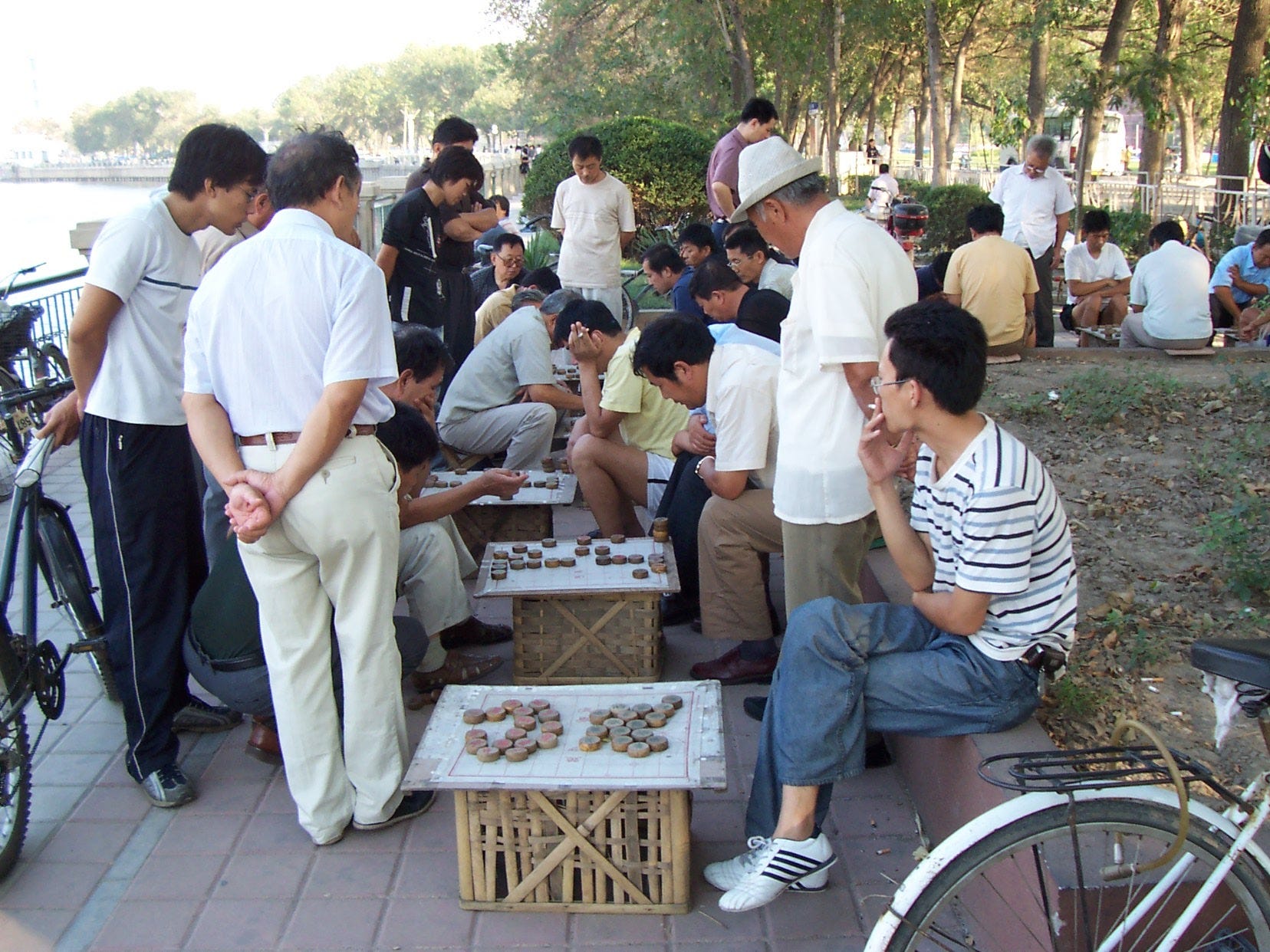
The contrast between the far eastern culture I have lived in for the last couple of years and what I see here in the Midwest could hardly be greater. In my neighborhood back in Shanghai I frequently see children from all over the community playing together, the elderly gathered on old wooden stools around small tables to play checkers or mahjong or cards, and families gathering on blankets at public parks to share snacks and laze around on blankets or under canopies. It’s not a utopian Shangri-la by any means, but something about the old men laughing and smoking and slapping each other on the back stirs a slight envy in me as an American man. Though I look for it here, I witness very little such closeness and community in these United States. Most folks here seem to prefer to remain in their air conditioned homes, glued to the blue light of TV screens or iPhones.
Don’t get me wrong: I can bed rot with the best of ‘em! But even as I do so, I know that like Esau of old I am consciously exchanging my birthright for a bowl of thin gruel.2
Robert Putnam’s book Bowling Alone: The Collapse and Revival of American Community has been commented on and revisited by myriad social commentators since its publication in 2000, and for very good reason. In it Putnam notes that the decline in social capital — the networks of trust, reciprocity, and civic participation that enables “thick” communities to flourish — has been easily apparent and quantifiable since the 1960s. He rightly notes that this loss of social capital has had profoundly negative consequences for American democracy, our physical and mental health, our levels of personal satisfaction with life, our educational success, and our economic prosperity.
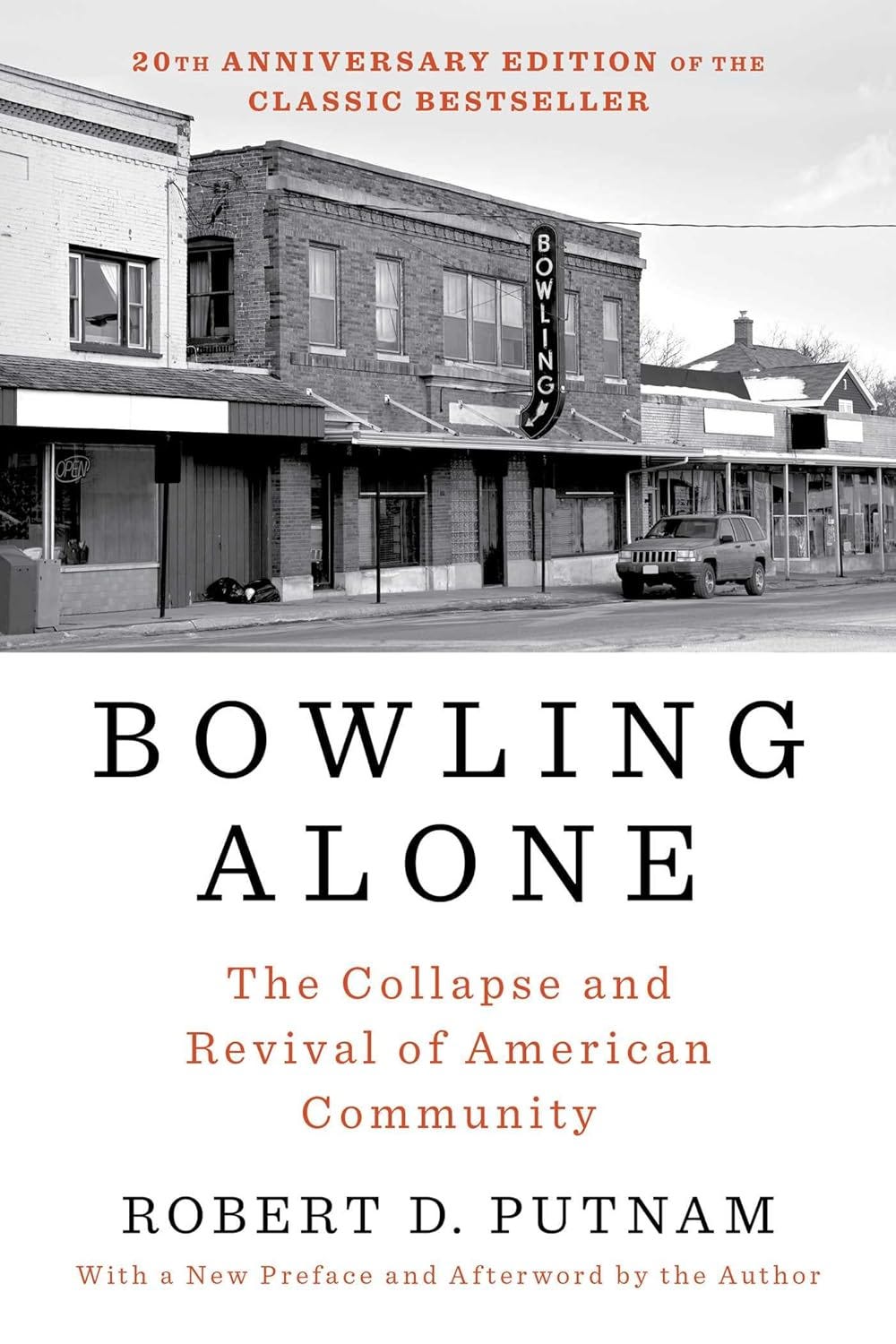
Now China has its issues to be sure, and I certainly do not want to fall into romanticizing the Far East as so many western observers have done for centuries. But in a very real and palpable sense the Chinese still value the common good and help one another through norms of reciprocity that have almost entirely collapsed in the Western world. While China stresses communality, working for the welfare of the wider culture, sacrificing for the sake of the whole, and building a future that will be brighter for successive generations, our own nation has seen a rapid decline and almost collapse in the voluntary associations that provided the social glue for the first two centuries of this nation’s history: church groups, PTA meetings, labor unions, Rotary Clubs, neighborhood associations, civic and voluntary organizations, and so on. Putnam notes that American went from bowling leagues to bowling alone.
What happens when this essential social glue begins to dissolve? Trust evaporates, suspicion of our neighbors rises, security cameras and alarm systems are installed, neighbors begin to quarrel with one another over petty and insignificant matters, and isolated, lonely individuals fall into forms of extremism and insanity. In Putnam’s words, “People divorced from community, occupation, and association are first and foremost among the supporters of extremism.”3 Is it any wonder that we see the rise of political violence in a society as lonely and nihilistic as ours?
And by the way, this trend has not only been documented by Putnam, but by a large host of very important sociologists and commentators in the last two decades. A few other books that are essential for understanding the nature of this crisis of loneliness include Putnam and Campbell’s American Grace: How Religion Divides and Unites Us (2010), Eric Klinenberg’s Palaces for the People: How Social Infrastructure Can Help Fight Inequality, Polarization, and the Decline of Civil Life (2019), former surgeon general Vivek Murthy’s Together: The Healing Power of Social Connection in a Sometimes Lonely World (2020), Marc J. Dunkelman’s The Vanishing Neighbor (2012), and Max Fisher’s The Chaos Machine: The Inside Story of How Social Media Rewired Our Minds and Our World (2023). Taken together, these books tell a coherent story that is vital for us to understand if we genuinely wish to seek the welfare of this broken city of Babylon: the social isolation that is spreading from the West to places across the world presents not merely an emotional and mental health challenge, but corrodes our civic institutions, our cultural heritages, our economic prosperity, and even our shared narratives that give our lives meaning and purpose. Sadly, I see the effects of this even among my junior high and high school students in Shanghai who are immersed in much of the same media and technology that we are in the west.
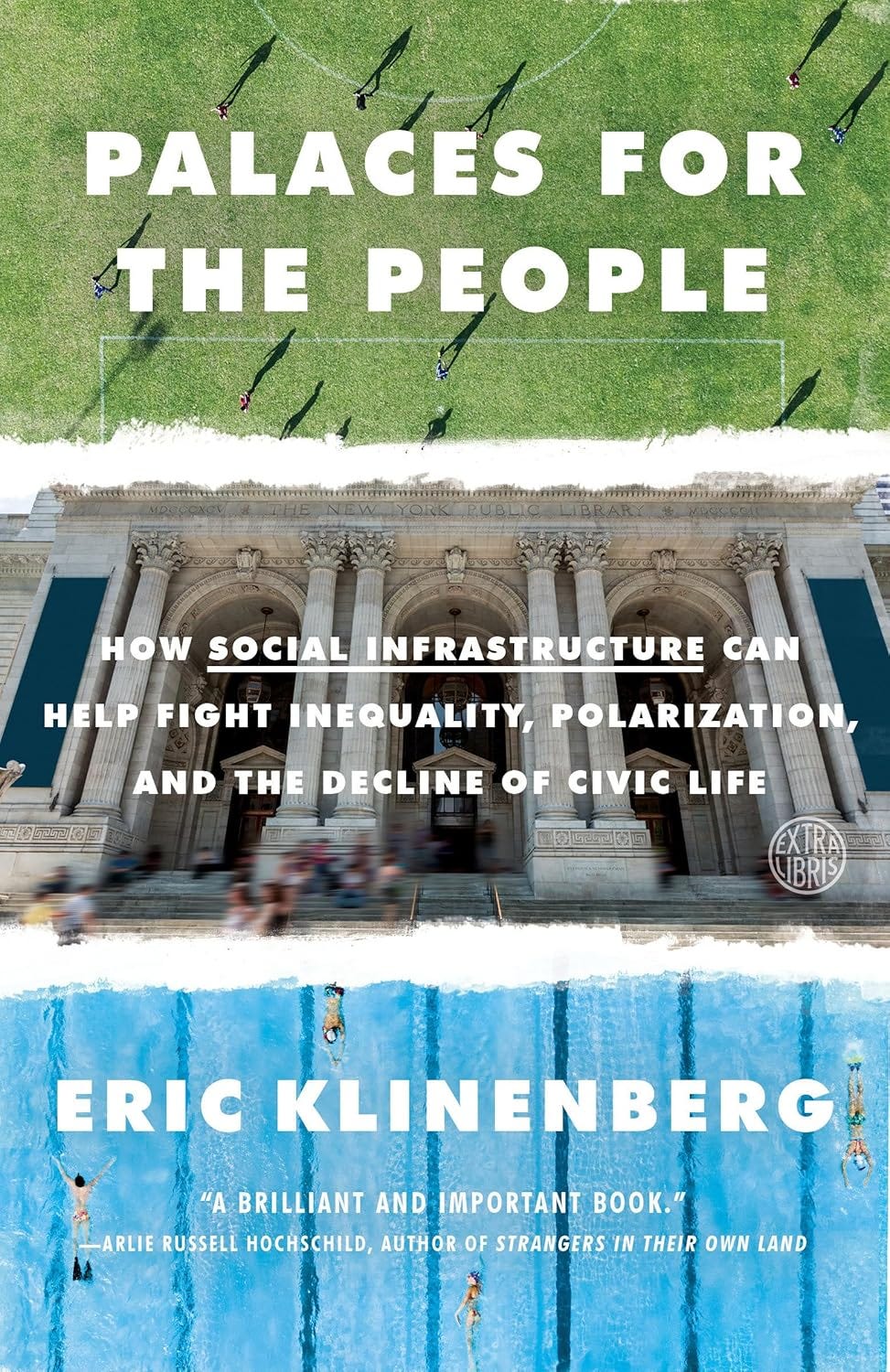
You have written before in these letters about the importance and centrality of friendship. And I wholeheartedly agree with you. But I’d like to present you with a challenge (perhaps for your next letter if you feel like it). It seems to me that simply building individual-level friendships one by one, while helpful and moving in the right direction, will ultimately be inadequate for the severity and scale of the challenge we face. We need a solution that moves beyond individual friendships and that instead strengthens our cultural institutions and institutional trust, that renews a sense of place (i.e. Klinenberg’s thesis in the book pictured above), and that re-introduces communal practices that enable people to form deep, lasting, and durable relationships across families, communities, and even social differences. As a historian of religion, it will not surprise you that I think the answer lies in a so-called “Third Great Awakening,” that is, a genuine revival of Spirit-led faith and religion (in its very best sense). But perhaps your diagnosis will be different than mine.
Perhaps this letter sounds too dire. If so, forgive me for that. I do ultimately have hope for the future of humanity and even for the particular nation-state of my birth, but as you know my hope is rooted in the nature of God and of the meta-narrative I believe we all find ourselves a part of. Perhaps I will write about that more later. But I hope that these musings from a man who has lived in China and is now temporarily re-entering the West will provide fodder for hope-filled thinking and reflection rather than hang-wringing.
Your Friend,
Greg
Let’s not forget that valuing the common good is the central tenant of Catholic Social Teaching, and also plays a central role in most Protestant ethics. Our lack of regard for it only further supports our argument that we live in pagan Babylon!
See Genesis 25:29-34
First edition, p. 338
Thanks for posting your thoughts, Greg. I always look forward to hearing about and reading your perspectives on your experiences in China. I think I probably fall into the category of those who romanticize certain aspects of the culture, take what I see in the media with a healthy grain of salt, and recognize how important lived experience is to truly understanding a place.
This letter came at a funny time for me personally. While I’ve never been blind to the isolating and lonely aspects of American life—especially suburban Texas—as the son of Latin American immigrants, I’ve always longed for a stronger sense of community, both within my own family and beyond. I especially appreciate that you approach this topic with the attitude of, “Yes, every place has its issues, so let’s not get too utopian.” It reminds me that my own perspective is far from perfect, too.
Two things have happened recently that have me feeling a little more optimistic.
The first is golf. Yes, golf.
For many reasons, I avoided golf my entire life. I wanted nothing to do with it, the places it was played, or—if I’m being honest—the people I associated with it. About three months ago, my closest friend insisted I join his team for a charity scramble. I said no. He said yes. Eventually, I gave in.
Ironically, throughout my advertising career, I’d sponsored plenty of charity tournaments but rarely did much more than shake hands with the clients whose entry fees I paid before expensing them.
After the ninth hole, while laughing at how terrible we both were, I turned to him and asked, “Have you looked at your phone? Have you seen the news today?”
He paused for a second and said, “Man… I haven’t. This is great. I had no idea. Let’s keep doing this.”
Neither of us had.
It occurred to me later that it had probably been years since we’d asked each other, “How are you? How are things at home?” Golf wasn’t the point. It just gave us the excuse to slow down long enough to ask.
And we’ve continued exploring this new hobby… or obsession.
It’s not always easy to carve out time to play together (especially since I’m trying to do it on the cheap), but golf has also given me something unexpected: a shared interest with my father-in-law. You may know him—he’s a pretty good guy.
There’s something wonderful about being able to call him just to laugh about a round or talk about how badly one of us played. It closes the distance a little and gives me the simple joy of thinking, “Wouldn’t it be fun if we could all play a round over Thanksgiving?”
The second is the World Cup.
You know I’ve been a lifelong fútbol fan, and every four years I happily accept that the World Cup will become my least productive month.
What has surprised me, though, has been how heartening it’s been to watch people from all over the world come to Dallas and genuinely enjoy my city. It’s been wonderful seeing visitors not only appreciate the places themselves but also comment on how friendly people have been, despite arriving with more than a little skepticism.
Above all, it’s reminded me how meaningful it is to gather—even on a random weekday—with family, friends, and neighbors to watch a match.
For example, I live in a downtown Dallas neighborhood with a shared dog park. Spending incredibly casual evenings watching games with our Argentine neighbor has been such an unexpected gift. The remarkable part, I suppose, is that it feels remarkable at all.
She’s also an immigrant, although she came here at a young age and most of her family still lives abroad. It awakened something in my parents. I think they saw a little of themselves from 45 years ago and, almost instinctively, decided to embrace a stranger. She’s now become part of our extended family and will almost certainly be joining our twice-a-month drives out to my parents’ house, where we’ll share a meal, chat for hours, and watch our collective seven dogs run around the backyard.
Are golf and the World Cup the answer? Of course not.
Is simply saying, “Hey, want to come over and watch the game?” or “Want to hit the driving range tomorrow?” the answer? Probably not either.
But can those little invitations help push back, even a little, against the forces that leave us isolated? I think they can.
And in the meantime… let’s go Argentina. ¡Vamos Argentina! And let’s pray Peru or Chile qualify for 2030!
Two only slightly connected thoughts:
1. I've not yet read the books you reference, but I've been meaning to ask after several of your (both Greg and Justin) letters -- and this is another reminder -- if you are familiar with Joseph Henrich's 2020 book "The WEIRDest People in the World"? (WEIRD being an acronym for Western, Educated, Industrialized, Rich, and Democratic). Among its several theses, the book devotes a lot of attention to the early Catholic Church's "marriage and family program" putting a taboo on cousin marriage, with the effect of weakening kinship bonds and leading to European populations that were more amenable to forming marital, but also social, economic, political, and intellectual bonds with non-relatives. This is, of course, a gross oversimplification on my part. But it certainly has me thinking about a Western (and according to Henrich also specifically Christian) bias toward individualism playing a role in making us Westerners more prone to loneliness. It's not just smartphones (but I'm not arguing that smartphones don't contribute).
Anyway, I found it a very thought-provoking read (if a bit of a slog).
2. I think there is also a role being played by affluence. I think many Americans (especially), craving individuality and independence, see wealth as the means to achieve it. Wealth means being able to have a detached house in the suburbs (or exurbs if the suburban taxes get too high) without having to worry about possible quarrels with neighbors. To own a car rather than riding the bus with other people. To send kids to a private school (or exercise "school choice") rather than attending the neighborhood public school. To overeat on whatever our evolutionary heritage has programmed us to crave (i.e. more calories). In that sense, American loneliness may just be an inevitable side-effect for getting what we want.
And as China and elsewhere become more affluent themselves, will they follow that path, even if more slowly?