

Taking Off My Hat
A Pride Post On Identity and Trying to Be An Ally/Friend

Dear Greg,
Hello from beautiful Morelia, Mexico.
A few months ago, I was driving through rural Arkansas on my way to Memphis, a drive I make semi-frequently. Somewhere along that particularly ugly stretch of I-40, I stopped for gas. Before I got out of the car, I removed my hat.
That probably doesn’t sound like much of a story. People take off hats all the time. But this one was different. It was a hat expressing support for LGBTQ people, and as I sat in the parking lot looking at the gas station entrance, I found myself wondering whether wearing it inside might invite trouble. Maybe nothing would have happened. Maybe my fears were exaggerated. But in that moment, I felt enough anxiety to take it off.
I wish I could tell you I left it on.
Instead, I tucked it away and walked inside.
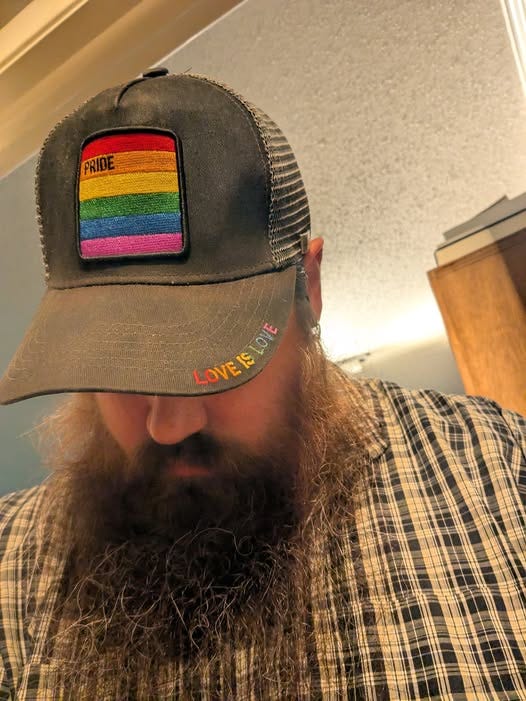
The whole episode lasted less than a minute, but it has stayed with me for months. It sill bothers me, hence why I am writing about it here. What lingered was not my fear so much as the privilege hidden within that small act. I could remove the hat because the hat was not me. It was a statement, a conviction, a gesture of solidarity. It was something I had chosen to wear. For many LGBTQ people, there is no equivalent option. They cannot simply remove a hat and stop being who they are, and in too many places that still puts them in danger.
As I drove east, I found myself thinking about the friends who made that hat possible in the first place. Twenty years ago, I would not have worn it. In fact, twenty years ago, I likely would have mocked someone who did. That is not a confession I enjoy making, but it is an honest one. I was decidedly bigoted towards LGBTQ folks.
If I am an ally today, it is not because I lost an argument or discovered the right theological formula. It is because of friendship. LGBTQ friends took time to love me, nurture me, and show me light of God in their lives. I could no longer deny that these friends were any less a part of God’s kingdom than straight folks.
Over the years, LGBTQ friends trusted me with their stories. They shared fears, wounds, hopes, and experiences that I had never had to navigate myself. They invited me into their lives, and in doing so they changed mine. As I sat in that parking lot, I could picture their faces. I thought about people who had patiently helped me become a better friend, a better Christian, and a better human being, all while trying to survive and flourish in a world that has not always wanted them. Some had endured rejection from family members. Some had experienced hostility from churches. Some had spent years wondering whether they would ever be fully accepted by the people they loved. Yet they continued extending friendship, grace, and patience to people like me. Looking back, I realize they taught me how to love long before they taught me how to think differently.
As you know, I have spent much of my life studying friendship. Aelred taught me that friendship opens us to God. Aristotle taught me that friendship shapes virtue. My LGBTQ friends taught me that friendship is one of the primary ways we learn to see people we once failed to see. Friendship has a way of exposing the poverty of our stereotypes. It is difficult to reduce someone to an issue once you have shared meals, exchanged stories, celebrated joys, and carried burdens together. Whatever growth has occurred in me on this subject has come largely through the patience of friends who allowed me to learn from them, challenged me when I needed challenging, and continued walking with me while I was still figuring things out. I considered naming several of them here, but given that some of them are still in precarious situations in parts of their lives, I decided not to mention any names, but I am surely picturing specific people’s faces as I write this.
That is one reason that removing the hat continues to bother me. It felt, however briefly, like a failure to live up to the gifts those friendships have given me. I know that removing a hat is not the same thing as abandoning a friend. Yet friendship calls us to bear one another’s burdens, and for a brief moment I chose safety over solidarity. The hat came off because I was afraid. That realization has left me wondering how often courage fails, not through dramatic betrayals, but through small acts of self-preservation. I failed to love because true love drives out fear.
I have also been thinking about Pride Month. Every year, there are arguments about what Pride means. Some view it as a celebration. Others see it as a partisan political movement. Still others regard it with suspicion. Yet I wonder whether Pride is often something simpler than either its supporters or critics imagine. Perhaps Pride is what happens when people grow tired of apologizing for existing. Perhaps it is what happens when people who have spent years hiding decide they can no longer bear the weight of concealment. Perhaps it is simply the refusal to disappear.
Many LGBTQ people have spent years being told, either explicitly or implicitly, that acceptance depends on remaining hidden. Don’t say too much. Don’t draw attention to yourself. Don’t let people know. Be someone else. Pretend. Conceal. For me, though, the hat came off too easily.
I always gotta return to my man, Bayard Rustin. You know that I have spent years studying Rustin’s life and thought. What first drew me to him was his commitment to nonviolence, economic justice, and his vision of beloved community. What keeps drawing me back is his conviction that friendship is not peripheral to justice. Friendship is one of the ways justice becomes possible, and friendship surpasses justice. Aristotle was right, “When people are friends, they have no need of justice, but when they are just, they need friendship in addition.”
The more I studied Rustin, the more I became convinced that friendship was one of the central themes of his life. He formed friendships across racial, economic, religious, and political lines all while being open about his sexuality. He believed that people become better by walking together, struggling together, and learning from one another. He spent his life helping enemies become neighbors and neighbors become friends. He understood that no one becomes fully human alone and that justice is not merely a matter of laws and institutions but of relationships rightly ordered toward one another.
Yet for much of his life, many people were unwilling to extend to Rustin the very friendship he extended to others. They admired his organizing. They relied upon his strategic brilliance. They welcomed his labor. But because he was a gay man, they often kept him at arm’s length, treating him as useful rather than beloved. We do this a lot. We welcome people’s labor while rejecting the people themselves. Many people wanted Rustin’s gifts without wanting Rustin himself.
What strikes me now is how deeply that contradicted Rustin’s own vision of community. The tragedy was not merely that Rustin suffered exclusion. The tragedy was that movements, organizations, and churches deprived themselves of the friendship he was offering them. They accepted what he could do while remaining hesitant to embrace who he was. In doing so, they undermined the very beloved community they claimed to seek.
As Christians, we speak often about courage. We celebrate martyrs, prophets, and saints. We admire those who stood against the crowd. Yet courage rarely arrives in dramatic moments. Most of the time it appears in ordinary decisions made by ordinary people: when someone tells the truth about themselves despite the risks, when someone refuses to laugh at a cruel joke, when someone stands beside a vulnerable neighbor, when someone wears their Pride hat no matter the location, when friendship costs something.
My brief moment at that gas station revealed something about myself. Twenty years ago, I would not have worn the hat. A few months ago, I wore the hat but took it off. Perhaps discipleship consists largely in recognizing the distance still left to travel.
This Pride Month, I find myself grateful for friends who have helped me see the world differently. I am grateful for those whose honesty enlarged my capacity for compassion. I am grateful for those who patiently remained my friends while I was still learning. I am grateful that they showed me Jesus even when I saw them as diabolical. Most of all, I am reminded that friendship is not merely affection. Friendship is solidarity. It is the refusal to abandon one another. It is the decision to say, “Your burdens matter to me because you matter to me.”
The Apostle Paul writes that if one member suffers, all suffer together. That vision leaves little room for indifference. The suffering of our neighbors is not theirs alone. It becomes ours as well.
So this Pride Month, I am thinking about a hat that came off too easily, friends whose burdens have helped shape my own life, and a gay Quaker from West Chester, Pennsylvania, who never stopped believing that the path to justice runs through friendship. I am also praying for a little more courage the next time I pull into a gas station. I’ve worn that hat every day in Mexico so far, and I intend to never remove it again simply because of fearing potential consequences. My LGBTQ friends are too important, and all LGBTQ people are because they are made in the image of the Triune God and deeply beloved by this God. God has invited them into friendship, so if I want to be friends with God, I need to be friends with God’s other friends.
Your Friend and Fellow Exile,
Justin
Amen brother.
Marvelous!